Your competitors have already spent money finding out which newsletters work. You can see the results for free, if you know where to look.
Every newsletter ad is public. It sits in an issue that thousands of people read, and often in a public archive too. So the question is not whether you can see where competitors sponsor. It’s how long it takes.
This guide covers three ways to do it, from fully manual to fully automatic, and a real example: where Semrush and Ahrefs, two direct competitors, sponsor newsletters in 2026.
The short answer
There are three ways to find out which newsletters your competitors sponsor:
- Check newsletter archives by hand. Open past issues of newsletters in your niche and look for ads marked “Sponsored by”, “Presented by” or “Together with”.
- Search Google. Search for
"Competitor name" "sponsored by" newsletterto find issues that mention them. - Use a newsletter sponsor tracker. A tool like Radar Lab reads thousands of newsletters and shows every newsletter a company has sponsored, how many times, and the real ads.
Whichever way you choose, count repeats. One ad is a test. Four ads in the same newsletter means it’s working for them.
Why competitor sponsorships are the best signal you have
Newsletters can tell you their subscriber count and open rate. They can’t easily prove their ads work. Your competitors can, by coming back.
A company that sponsors the same newsletter three or four times is telling you something no media kit can: the ads paid off.
That’s why competitor sponsorship research is the fastest way to build a shortlist. It shows you:
- Which newsletters reach your buyers. If a competitor sells to the same people you do, their newsletters are your newsletters.
- Which newsletters actually work. Repeat sponsorships are proof, not promises.
- What the ads look like. You see their offer, headline and call to action.
- Where the gaps are. Newsletters your buyers read that no competitor has found yet are often the cheapest wins.
Method 1: Check newsletter archives by hand
This takes time but costs nothing.
- List 10 to 20 newsletters your buyers read. Ask customers, check what your team reads, and look at our newsletter shortlists by audience.
- Open each newsletter’s public archive. Most newsletters on Substack, beehiiv and Ghost have one at
/archiveor/p/. - Read the last 3 to 6 months of issues. Look for the labels newsletters use for ads: “Sponsored by”, “Presented by”, “Together with”, “Brought to you by”, “Today’s sponsor” or “(Sponsor)”.
- Log every ad in a sheet. One row per ad: newsletter, date, sponsor, where the ad sat (top, middle, bottom), and the offer.
- Count repeats per sponsor. Sort by competitor, then by newsletter.
A simple sheet looks like this:
| Newsletter | Date | Sponsor | Slot | Offer |
|---|---|---|---|---|
| Newsletter A | 2 Oct 2026 | Competitor X | Top | Free trial |
| Newsletter A | 16 Oct 2026 | Competitor X | Top | Free trial |
| Newsletter B | 9 Oct 2026 | Competitor Y | Middle | Webinar |
How long it takes: about 5 to 10 minutes per newsletter for a few months of issues. For 20 newsletters, plan on half a day, and you’ll need to do it again next month.
Method 2: Search Google for sponsor mentions
Google can find issues that mention a competitor as a sponsor. Try searches like:
"Competitor name" "sponsored by""Competitor name" "presented by" newsletter"Competitor name" sponsor site:substack.com"Competitor name" sponsor site:beehiiv.com
Also check:
- The competitor’s own social posts. Brands often share newsletter features they paid for.
- Their “as seen in” sections on their site.
- The newsletter’s “Advertise” page, which sometimes lists past sponsors.
The catch: Google only finds issues it has indexed, and many newsletters don’t publish every issue on the web. You’ll find some sponsorships, but rarely all of them.
Method 3: Use a newsletter sponsor tracker
A newsletter sponsor tracker reads newsletters for you, every day, and records every ad. Instead of searching archives, you type a competitor’s name and see their full sponsorship history.
Radar Lab is built for this. It reads 4,736 newsletters and has logged 9,110 sponsorships from 1,899 brands so far. For any company, it shows:
- every newsletter they sponsored
- how many ads they ran in each one, and when
- which sponsorships are repeats (the strongest signal)
- the actual ads, so you can see their offer and copy
- newsletters that fit your buyers where no competitor sponsors yet
Here’s what that looks like for one real competitor:
Semrush semrush.com
Sponsored 14 newsletters · 131 ads found · 49 in the last 90 days
| Newsletter | Ads | Last ad | Signal |
|---|---|---|---|
| Product-Led SEO | 34 | 8 Oct 2026 | Repeat since May 2025 |
| SEOFOMO | 25 | 1 Nov 2026 | Repeat since May 2025 |
| #SEOForLunch | 17 | 27 Oct 2026 | Repeat since May 2025 |
| Venture Daily Digest | 15 | 2 Nov 2026 | New since Sep 2026 |
| Devshot | 10 | 26 Oct 2026 | New since Oct 2026 |
Open lane: Organic Hackers. Ahrefs ran 29 ads there; Semrush has none.
Now compare it with a direct rival.
Real example: where Semrush and Ahrefs sponsor newsletters
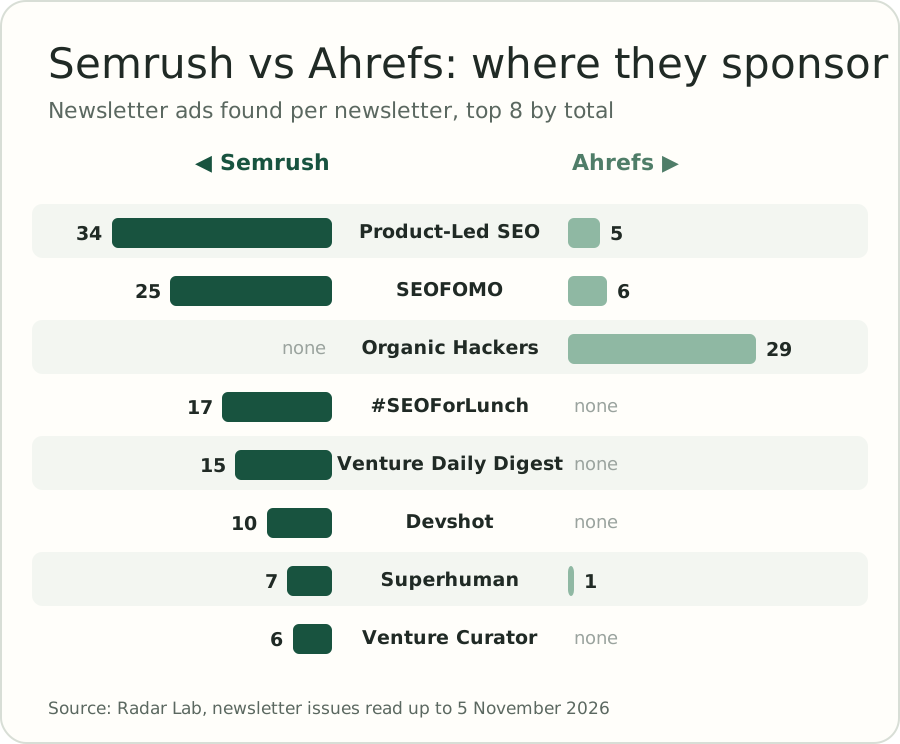
Semrush and Ahrefs are direct competitors. Both sell SEO software to marketers. Here’s where each one sponsored newsletters, from Radar Lab’s data up to 5 November 2026.
| Semrush | Ahrefs | |
|---|---|---|
| Newsletters sponsored | 14 | 17 |
| Ads found | 131 | 67 |
| Ads in the last 90 days | 49 | 6 |
| Newsletters with repeat ads | 12 | 9 |
| Newsletters they both sponsor | 4 | 4 |
What the data shows
1. Semrush goes deep. Ahrefs goes wide. Semrush ran 76 of its 131 ads (58%) in just three SEO newsletters: Product-Led SEO (34 ads), SEOFOMO (25) and #SEOForLunch (17). Ahrefs spread 67 ads across 17 newsletters, and 8 of those got only one ad. One approach rewards newsletters that work. The other is still testing.
2. Repeat sponsorships show what works. Semrush has sponsored SEOFOMO since May 2025 and was still there on 1 November 2026, with 25 ads. Ahrefs tried SEOFOMO too: 6 ads between January and March 2026, then stopped. When one competitor keeps paying and another quits, that’s worth knowing before you book.
3. Competitors follow each other. Semrush has run 34 ads in Product-Led SEO since May 2025. Ahrefs joined on 30 July 2026 and has run 5 ads since. If you sell SEO tools, that newsletter has now been checked by two of the biggest buyers in your market.
4. New tests show where a competitor is heading. Since September 2026, Semrush started sponsoring newsletters outside SEO: Venture Daily Digest (15 ads since 15 September), Devshot (10 ads since 1 October) and Venture Curator (6 ads since 1 September). That’s a move toward founders and developers, and you can spot it months before it shows up in a case study.
5. The gaps are opportunities. Ahrefs ran 29 ads in Organic Hackers between February and June 2026. Semrush has never sponsored it. If you compete with Semrush, that’s a newsletter your rival hasn’t tried, and one that Ahrefs trusted enough to sponsor 29 times.
You can see the full list of newsletters that brands in this space sponsor in our SEO newsletter shortlist and the SEO newsletter advertising report.
Do this for your competitors
See every newsletter your competitors sponsor, with the real ads.
Type a competitor's name into Radar Lab and see where they sponsor, how often they come back, and what their ads say. The 5-day free trial includes sponsor history for 2 competitors. No card needed.
Check your competitors freeWhat to look for in a competitor’s sponsorships
Once you have the data, these five signals matter most:
| Signal | What it tells you | What to do |
|---|---|---|
| Repeat ads in one newsletter | It works for them | Put it on your shortlist |
| One ad, then nothing | They tested and probably stopped | Ask the newsletter why, or skip it |
| A new newsletter this month | They’re testing a new audience | Watch the next 2 to 3 months |
| Two competitors in one newsletter | The audience is proven | Book early, and make your ad stand out |
| A good-fit newsletter with no competitors | An open lane | Test it first, often at a better price |
Also read the ads themselves. Note the offer (free trial, template, webinar), the headline and where the ad sits. Our newsletter ad examples and ad copy guide show what tends to work.
Tools that track newsletter sponsorships, compared
| Tool | Built for | What it shows | Price |
|---|---|---|---|
| Manual research | Anyone with time | Whatever you find in archives and search | Free, plus hours each month |
| Radar Lab | Brands buying newsletter ads | Every newsletter a company sponsored, repeat ads, the actual ads, and newsletters that fit your buyers | 5-day free trial, then $49 a month, or $29 one-time for 5 days |
| SponsorGap | Started for creators pitching brands, now also has tools for brands | Brands and the newsletters they sponsor, with contacts | $39 to $199 a month |
| Who Sponsors Stuff | Newsletter ad sales teams | A database of brands that buy newsletter ads | Free browsing; Sales Pro on request |
| Newsletter Insights | Newsletter research and analytics | Growth, revenue and engagement across many newsletters | Free to $149 a month |
The main difference: most sponsor databases were built to help newsletters find advertisers. Radar Lab is built for the other side, to help brands decide where to advertise, starting from who your buyers are and what your competitors already proved.
How to turn competitor research into your first sponsorship
- Pick 3 to 5 competitors who sell to the same buyers you do.
- List every newsletter they sponsored in the last 12 months.
- Keep the ones with repeat ads. These are your strongest candidates.
- Add 2 or 3 open lanes: newsletters your buyers read where no competitor sponsors yet.
- Check fit and price with our newsletter sponsorship checklist and ad rates by niche.
- Test 2 newsletters first, one proven and one open lane, and track the results with UTM links.
- Keep watching. Competitors start and stop sponsorships every month. A weekly check catches new tests early.
Radar Lab does steps 2, 3, 4 and 7 for you: it tracks up to 25 companies, sends a weekly Radar Brief, and alerts you when a competitor starts sponsoring a new newsletter. You can even ask about it in plain words from ChatGPT or Claude.
Only need it once?
Research 5 competitors in one go for $29.
The Research Pass gives you 5 days of everything in Radar Lab Pro: full sponsor history, the real ads, and newsletter picks for your business. It never renews.
See the Research PassFrequently asked questions
How do I find out which newsletters my competitors sponsor?
Check the archives of newsletters in your niche for ads labelled “Sponsored by” or “Presented by”, search Google for your competitor’s name plus “sponsored by”, and log every ad you find. For a complete list, use a newsletter sponsor tracker like Radar Lab, which shows every newsletter a company has sponsored, how often, and the actual ads.
Is there a tool that shows which newsletters a company sponsors?
Yes. Radar Lab tracks sponsorships across 4,736 newsletters and shows each company’s full sponsorship history, including repeat ads and the ads themselves. SponsorGap and Who Sponsors Stuff also keep sponsor databases, mostly aimed at newsletters looking for advertisers.
Is it legal to research a competitor’s newsletter ads?
Yes. Newsletter ads are published to readers and often to public archives. Looking at them is the same as looking at a competitor’s billboard or search ad. Just don’t copy their ad word for word.
How can I tell if a competitor’s sponsorship is working?
Look for repeats. A company that sponsors the same newsletter three or more times is very likely getting results, because nobody keeps paying for ads that don’t work. A single ad followed by nothing usually means a test that didn’t continue.
How far back can I see a competitor’s sponsorships?
By hand, as far back as the newsletter’s archive goes. In Radar Lab, history goes back to the first issue we’ve read for each newsletter, which for some newsletters goes back to 2021.
Should I sponsor the same newsletters as my competitors?
Often, yes, if the readers match your buyers and your competitor keeps coming back. But also test newsletters your buyers read where no competitor sponsors yet. You’ll face less competition for attention and often a better price.
Final thought
Your competitors have already paid to learn which newsletters work. Their repeat sponsorships are the cheapest market research you’ll ever get.
Start with a few competitors and a simple sheet. When you’re ready to stop checking archives by hand, try Radar Lab free for 5 days and see every newsletter your competitors sponsor, with the real ads as proof.